Gillerfors, G. (1986): Two new species of the genus Tarphius Erichson from La Gomera (Canary Islands) and designation of lectotypes of Tarphius humerosus Wollaston and T. gomerae Franz (Coleoptera, Colydiidae) - Vieraea, 16:3-10 >>>"F:\taxa\coleo\scans\Gillerfors1986 Tarphius Gomera.pdf"
This is the original text of Gillerfors (l.c.).
Not in the key are
unknown to me ...stagosus Gillerfors & Oromí, 1991
see main key >>>Tarphius ...canariensis Wollaston 1862
...elongatus Dajoz, 1971
#1
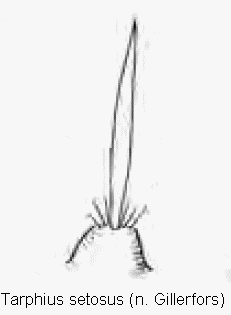
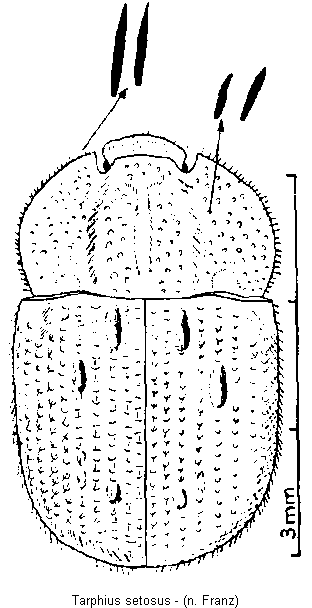
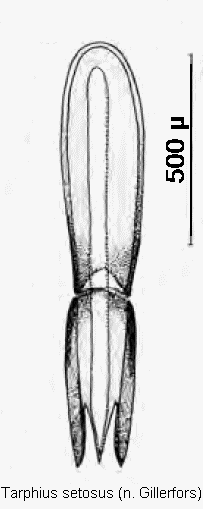
setosus Wollaston, 1865Upper surface and margin of pronotum and elytra densely covered with very long, erect, narrow and acute setae, surrounded by extremely delicate hairs, visible at 100 x [Abb. 1]; on elytra setae placed in rather distinct rows. Elytra with light and dark pattern. Granulae and nodulae on elytra weakly developed. (Nodulae more prominent in very large specimens). Habitus [Abb. 2]. Aedeagus [Abb. 3]. 2,6-4,4 mm. La Gomera and El Hierro.
Abb. 1Abb. 2Abb. 3
→ 2-Upper surface more sparsely covered with shorter, more obtuse or truncate setae, if acute, shorter not placed in distinct rows. Elytra without light and dark pattern, at most top of nodulae Iighter.
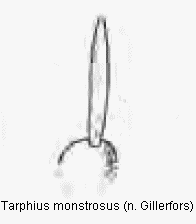
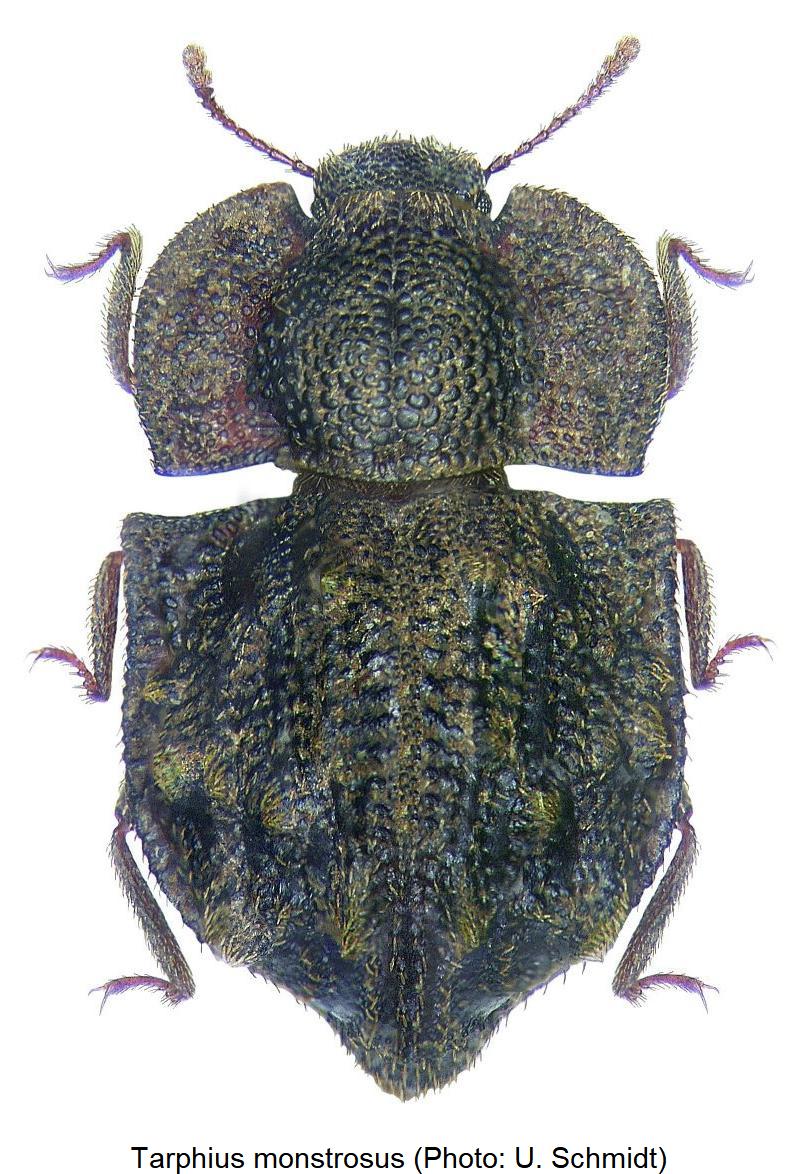
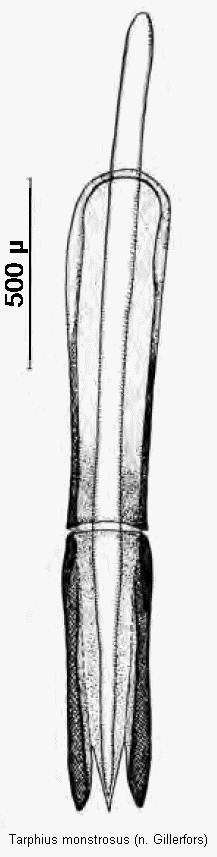
monstrosus Wollaston, 1865Larger species. Body length 5 mm or more. Elytra rather strongly convex, at suture roofshaped, with shallow punctures and granulae, rather obscurely setaceous with decumbent, obtuse setae [Abb. 4]. Nodulae small but prominent, rather distinctlv setiferous. Pronotal margins almost without setal fringe. Pronotum about twice as broad as long (only humerosus has pronotum this broad). Habitus [Abb. 5]. Aedeagus [Abb. 6].
Abb. 4Abb. 5Abb. 6
→ 3-Smaller species. Body length less than 5 mm. Elytral sculpture more rough. Setae more evident, erect or semi-erect.
→ 4Pronotum anteriorly on each side with round deep pits. Elytra slightly depressed, with anterior and median shallow depressions on disc and with well marked longitudinal ridges laterally. Nodulae weak. Setae rather long with distinctly obtuse or truncate apex.
→ 5-Pronotum without deep pits. Elytra convex, without depressions and ridges on them. Setae with more or less acuminate apex.
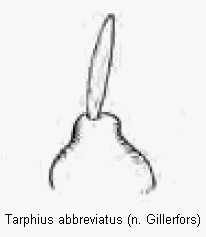
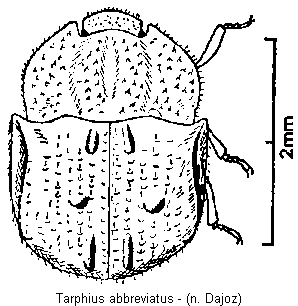
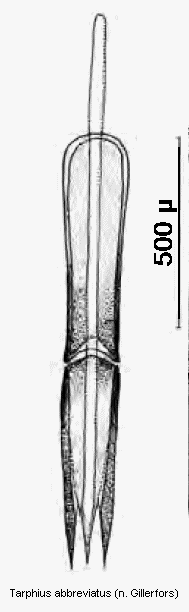
abbreviatus Wollaston, 1865Generally smaller species, 2.8-3.6 mm. Body form compact, squarish. Greatest width of pronotum slightly behind middle. Elytra conspicuously broader than long, greatest width in middle and lateral edge slightly convexo Pits on pronotum small not very deep. Setae of about uniform width with obtuse apex [Abb. 7]. Habitus [Abb. 8][Abb. 9]. Aedeagus [Abb. 10].
Abb. 7Abb. 8Abb. 9Abb. 10
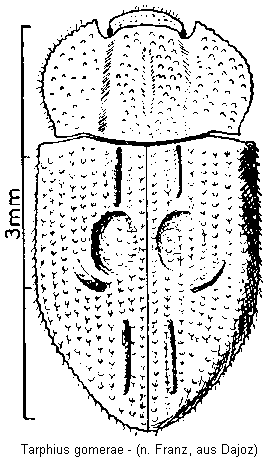
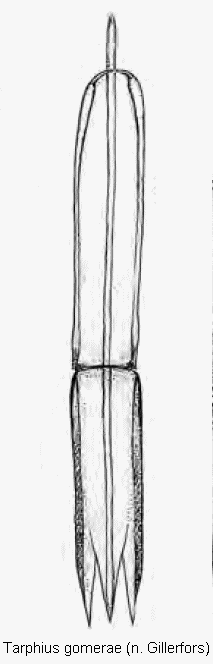
gomerae Franz, 1967-Generally larger species, 3.1-4.2 mm. Greatest width of pronotum in middle. Elytra about as broad as long, greatest width at shoulders, sides subparallel, straight. Pits on pronotum prominent and deep. Setae rather long, narrow, feebly dilated towards apex, this truncate [Abb. 11]. Habitus [Abb. 8]. Aedeagus [Abb. 12].
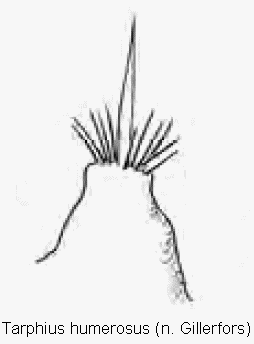
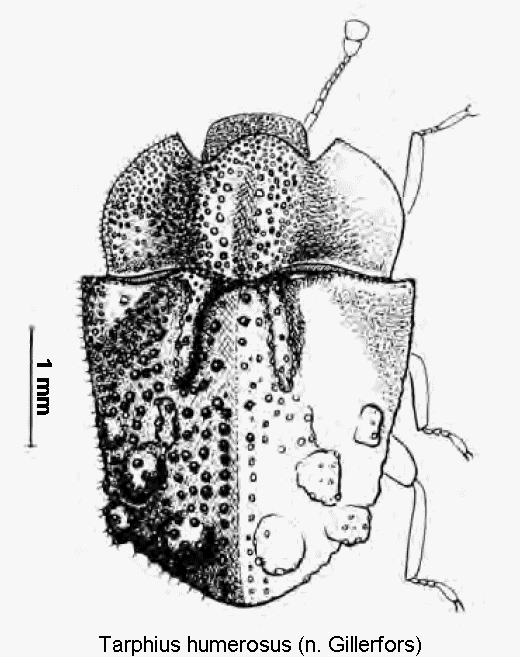
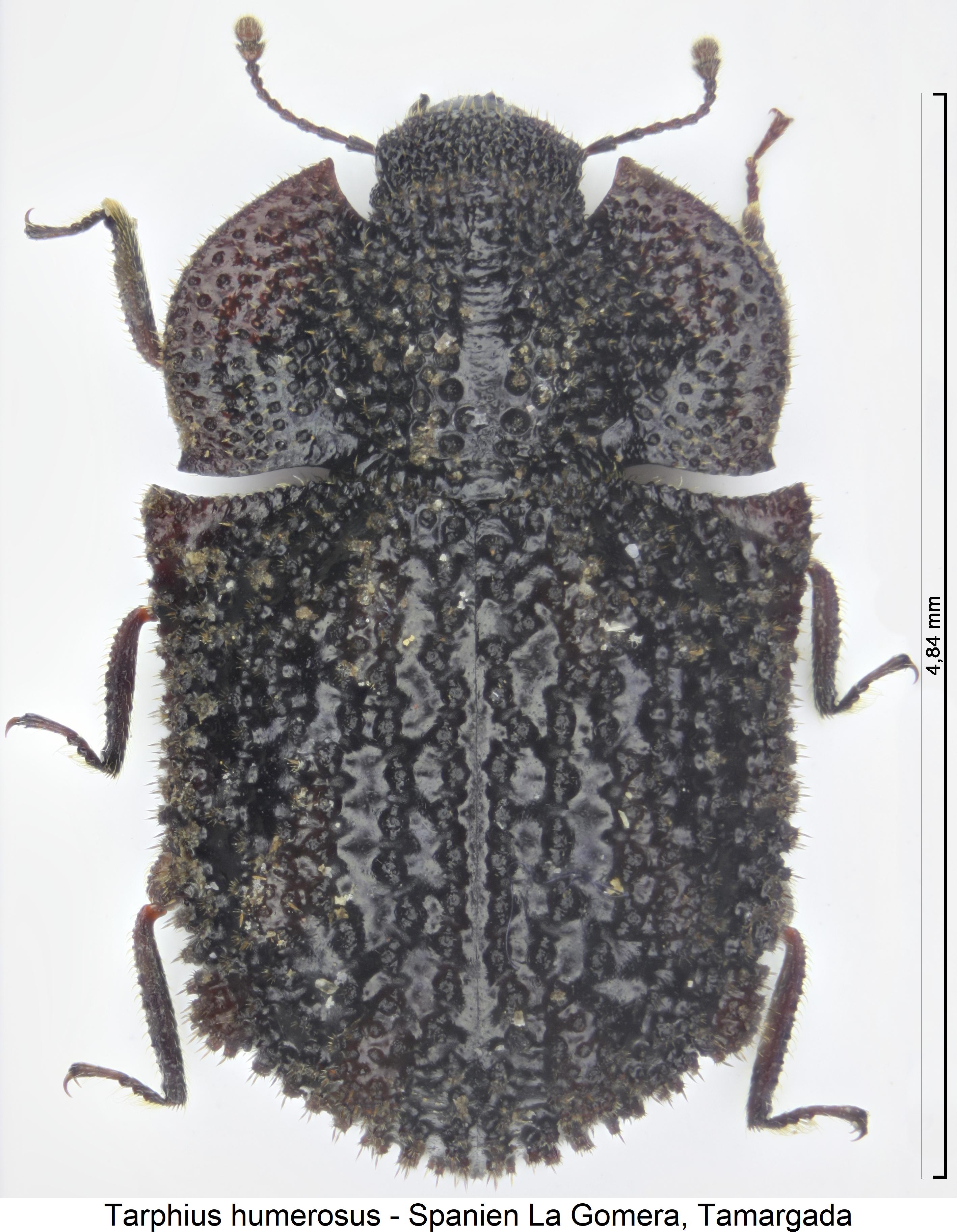
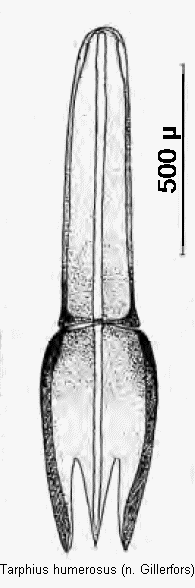
humerosus Wollaston, 1865Body surface covered with conspicuously elevated granulae. Posterior nodulae very prominent. Both granulae and nodulae with fine, acute, erect setae, surrounded with minute hairs [Abb. 13]. Pronotal margin also with these setae and hairs. Pronotum about twice as broad as long. Habitus [Abb. 14][Abb. 15]. Aedeagus [Abb. 16]. 4,5 mm.
Abb. 13Abb. 14Abb. 15Abb. 16
→ 6-Body surface not conspicuously granulated. Posterior nodulae not prominent. Body with more obtuse, narrowly elliptical setae and without hairs at base. Pronotum not twice as broad as long.
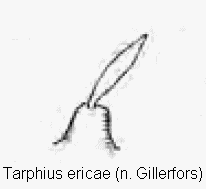
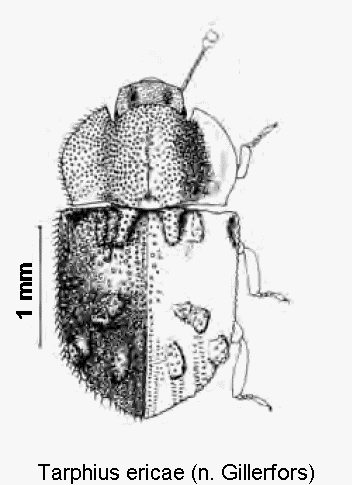
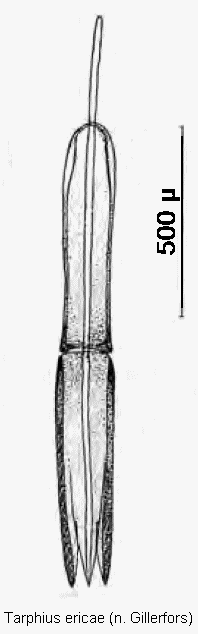
ericae Gillerfors, 1986Generally smaller species, 2.7-2.9 mm. Body more elongate, about 1.9 times longer than broad. Elytra with rather shallow punctures and small distinct granulae in more or less irregular rows. Nodulae weakly developed, somewhat lighter than rest of surface. Humeral angle not produced. Setae as [Abb. 17]. Habitus [Abb. 18]. Aedeagus [Abb. 19].
Abb. 17Abb. 18Abb. 19
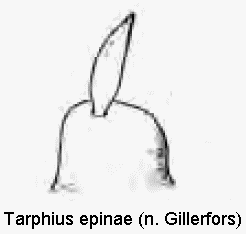
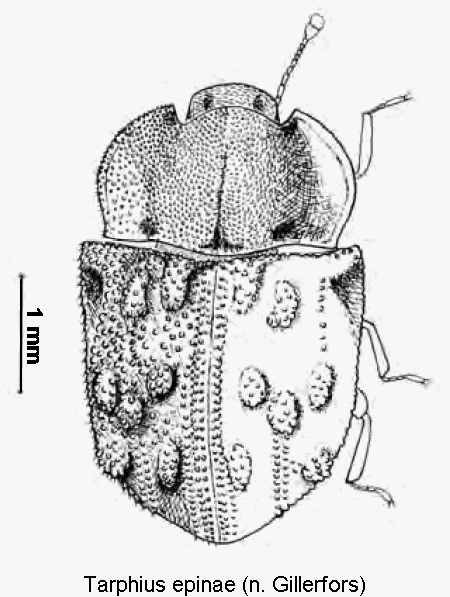
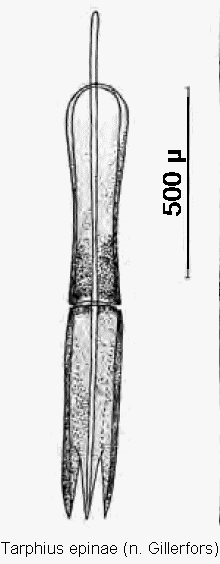
epinae Gillerfors, 1986-Generally larger species, 2.5-3.8 mm (mostly more than 3.0 mm). Body rather broad, about 1.6 times longer than broad. Elytra with rather deep, coarse and irregular punctures and more evident granulae. Nodulae more pronounced, concolourous with rest of surface. Humeral angle prominent. Setae as [Abb. 20]. Habitus [Abb. 21]. Aedeagus [Abb. 22].

 Käfer Europas herausgegeben von Arved Lompe sind lizenziert unter den Bedingungen der Creative Commons International 4.0 Lizenz BY-SA (Namensnennung-Weitergabe unter gleichen Bedingungen)